
OysterCatcher Fall 2026

Nutrient and Water Quality in Apalachicola Bay

Left: A look into the inside of the ISCO post-sampling. Right: Cat Point water quality station.
Research staff continue to complete routine fieldwork for our nutrient and water quality monitoring programs. These programs are part of the National Estuarine Research Reserve’s System-Wide Monitoring Program (SWMP) and occur monthly.
While in the field, staff collect water samples at eleven sites to monitor spatial and temporal fluctuations in nutrient and chlorophyll-a concentrations. Samples are also collected by an ISCO (pictured here). The ISCO is an instrument that automatically samples water over a 25-hour period. Once this period has elapsed, the ISCO's samples are retrieved and brought back to the Reserve's lab where they are filtered. All samples are then transported to and analyzed at the Department of Environmental Protection’s lab in Tallahassee.
In addition, 7 continuous water quality monitoring instruments are retrieved and swapped out with freshly calibrated equipment, leading to little or no gaps in data. Data is collected at 15-minute intervals, allowing the Reserve to monitor a suite of abiotic parameters such as temperature, salinity, pH, turbidity, dissolved oxygen, and water level.
The data obtained from these 2 programs allows the Reserve to track short- and long-term changes, providing valuable insight into the overall health of the Apalachicola Bay system. To learn more about SWMP, a StoryMap has been created and can be accessed here.
Trawl Sampling
Research staff joined forces with stewardship to complete this year’s summer and fall trawl sampling. Trawling is conducted quarterly at nine stations in Apalachicola Bay. At each station, five two-minute tows are performed. A trawl net is deployed off the boat and towed along the bottom of the bay. When two minutes have elapsed, the net is brought in and staff evaluate the catch.
Fish and invertebrates are identified to species level and the first 20 of each species are measured, while all are counted. Organisms are returned to the water as soon as possible to minimize mortality. This long-term monitoring program was established in 2000 and continues through present day. The data collected from this program allows the Reserve to study long-term trends in the fish and invertebrate communities of Apalachicola Bay.
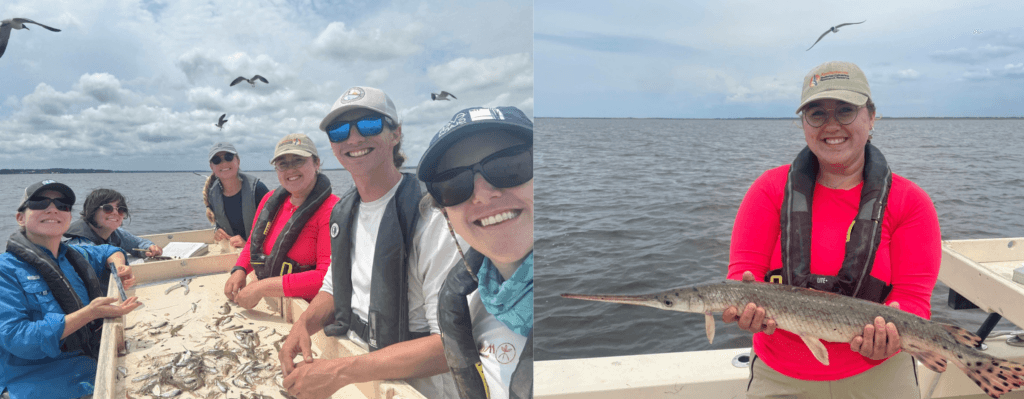
Left: Trawl crew (L to R): Megan, Madi, Meredith, Juliana, Michael, and Sam. Right: Juliana prepares to release a longnose gar back into the bay.
Research Intern Recap
In September the research team said farewell to our summer intern, Madi Meadows. During her internship Madi participated in a wide range of field work – she joined the team on datalogger deployments, nutrient collections, and trawl surveys. Madi also assisted with sea turtle nesting surveys on Little St. George Island with the Reserve’s stewardship department. When not in the field, Madi learned how to calibrate and maintain dataloggers, work with datasets, and create figures. She has been a valuable member of the research team, and we are thankful for all her hard work!
Madi has started her next adventure with the Central Panhandle Aquatic Preserve as an Environmental Specialist. Congratulations!

Left: Madi recording post-deployment readings from the Reserve’s data sondes. Right: Madi practicing her boating skills aboard the R.V. Henry Lee.
The Reserve Co-Hosts Nature-Based Solutions Workshop with Florida Corps and Local Partners
On August 5, the Reserve co-hosted a regional workshop with the Florida Corps, The Nature Conservancy's (TNC) Scaling Up Nature-Based Solutions (SUNS) initiative, and Gulf Corps to identify and prioritize future restoration projects across Franklin, Gulf, and Bay counties.
The workshop brought together local stakeholders to evaluate potential sites where nature-based solutions—such as living shorelines, rain gardens, and tree planting—could be implemented with assistance from the Florida Corps. The Florida Corps is a regional conservation program dedicated to restoring and protecting coastal and forest ecosystems throughout the Florida Panhandle while training a skilled workforce to carry out habitat restoration and community resilience projects.
Chris Shepard, Director of Science for The Nature Conservancy's Gulf Program, facilitated the meeting, providing an update on projects submitted through the SUNS initiative and the progress made since the program launched in 2020. Participants then used an interactive web-based mapping application to identify and prioritize additional restoration opportunities throughout the region. Discussions focused on project selection criteria, community priorities, and opportunities for collaboration, with several projects identified for potential future funding.
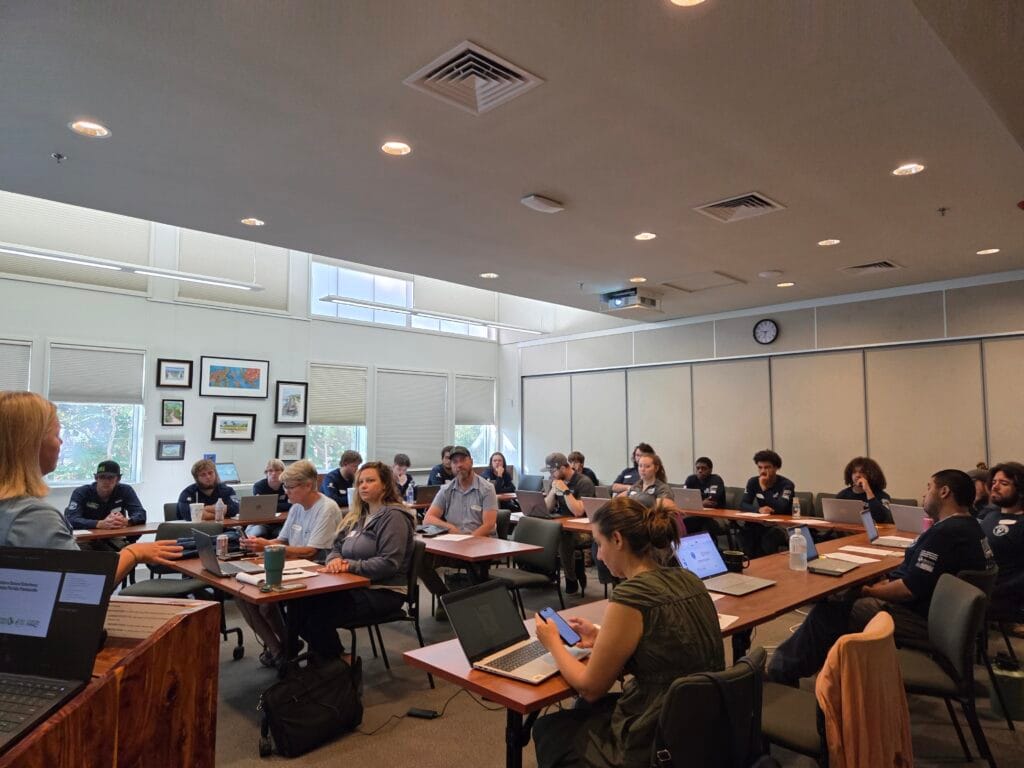
TNC’s Dr. Chris Shepard addressing the workshop.
Approximately 30 participants attended the half-day workshop, including Apalachicola Reserve Restoration Coordinator Ale Rios and Training and Engagement Coordinator Anita Grove; Sharon Cilano, the new UF/IFAS Extension Agent; 12 members of the Florida Corps and Oyster Corps; Joe Taylor with Florida Corps and Franklin's Promise; Destiny Bates with the Apalachee Regional Planning Council; Will Mather with WSP; City Commissioner Donna Knutson; Chris Shepard with The Nature Conservancy; Meg Christopher with the Central Panhandle Aquatic Preserves; and Bird Davidson with Gulf Corps.
The Reserve has participated in the SUNS initiative since its inception in 2020. The SUNS team plans to continue convening Florida Corps members and regional partners throughout the Florida Panhandle and Gulf Coast to strengthen partnerships and advance nature-based solutions that enhance coastal resilience, restore critical habitats, and support sustainable communities.
Conservation Pathways Visits the Apalachicola Reserve
Conservation Pathways Executive Director Rebecca Means and six of her students visited the Apalachicola Reserve on September 19 to explore potential careers in the environmental sciences. Training and Engagement Coordinator Anita Grove met with the students and shared the Reserve’s Meet the Staff story map, which illustrates the career paths Reserve staff took to reach their current positions. Following the discussion, the students visited the exhibits in the Nature Center and watched the Apalachicola River and Bay: Connected Ecosystem film.

Conservation Pathways visits the Reserve’s nature center.
Conservation Pathways helps future conservation leaders find their way in the environmental sciences by providing students with field research, science communication, and professional development experiences. The program serves college and high school students who are exploring careers in natural resource management and provides short-term field research and volunteer opportunities. Conservation Pathways typically works with student organizations but also welcomes individuals interested in learning more about field research and careers in the natural resource professions.
Franklin 98 Partners Explore New Shoreline Planting Method
Partners in the Franklin 98 project met at the Reserve in late September with Dr. Mark Clark to explore a new method for planting shoreline vegetation. Franklin 98 is a coastal restoration project in Franklin County, Florida, that uses nature-based oyster reefs and salt marshes to protect a vulnerable stretch of U.S. Highway 98 from chronic erosion and storm damage. Working with Alachua County farmer Chuck Todd, Dr. Clark, of the University of Florida’s Department of Soil, Water and Ecosystem Sciences, is developing a method to improve the establishment and effectiveness of shoreline vegetation.

Florida Corps member Ethan Fraizer and Dr. Mark Clark discussing Spartina patens.
The group met at the Reserve for an overview of the planting method, toured the Reserve’s Spartina nursery overseen by FloridaCorps, and visited three potential project sites where experimental Spartina patens plantings could be established. By the end of the week, FloridaCorps is expected to plant approximately 1,300 linear feet of Spartina patens.
The plantings will provide an opportunity to evaluate how the technique performs under local conditions and its potential for future shoreline restoration projects. Franklin 98 partners will monitor the plantings and report their observations and results to Dr. Clark.

Franklin 98 site visit and shoreline assessment for Spartina patens.
Franklin 98 partners include Apalachee Regional Planning Council, WSP, Florida Corps, Apalachicola Reserve, FWC, and Harter Restoration and Consulting, LLC, Coastline Clearing & Development Company.
Tropical Storm Bertha Affects Sea Turtle Nests
Sea turtle nests on both Little St. George Island (LSGI) and Carrabelle Beach were affected by storm surge from Tropical Storm (TS) Bertha. On Little St. George Island, 149 nests were present when impacts from TS Bertha occurred. Of these, 88 were washed over, one was partially washed out, and 51 were completely washed out. Many of the nests that were washed over also had a large amount of sand deposited on top of them, measuring 20 cm at one of the evaluations completed. Since the storm, there has been new nesting activity on the island. In Carrabelle Beach, 3 nests were present at the time of Bertha’s impacts. Two of these nests were completely washed out. The third nest was washed over but did not have any accretion like those on LSGI. Volunteers reported that storm surge was likely over the first dune and a lot of debris had washed in. Staff documented the nests impacts and cleaned up from the storm surge. A full 2026 nesting report for both beaches will be coming soon after the season officially ends on October 31st!

New nest on Little St. George Island post Tropical Storm Bertha.
Stewardship & Research Attend FSU Coastal and Marine Lab’s Scientific Data Workshop
Staff from the Reserve’s Stewardship and Research teams attended a scientific data workshop at the Florida State University Coastal and Marine Lab (FSUCML) in St. Teresa, Florida. FSUCML’s Quantitative Ecologist, Dr. Beatriz Mejía-Mercado, taught methods of data quality assurance and control, and reviewed ways to visualize and validate datasets. She then went over best practices for organizing and storing data, and how to create thorough metadata. After every section, participants had time to work on applying each concept to their own dataset. The workshop also covered steps for publishing data in different repositories and encouraged data sharing and accessibility. Staff now have more tools to help ensure the data that comes from the reserve’s programs is high quality.

Photos from the FSU Coastal and Marine Lab Scientific Data Workshop.
Stewardship Staff Completes Mangrove Monitoring
Stewardship staff recently completed the 2026 monitoring of mangrove transects in Apalachicola Bay. Staff monitor eight transects annually on St. George Island and Little St. George Island. This is part of a long-term monitoring project which started in 2018 to research how mangroves are expanding northward in their range. Currently Apalachicola Bay is home to both red (Rhizophora mangle) and black mangrove (Avicennia germinans).
During surveys, multiple measurements are taken on individual tagged trees to monitor growth rates and response to stressors such as freeze events. Additional mangroves that recruit in the transects are counted.

Left: Bekah and Juliana measuring a red mangrove. Right: Stewardship team with a black mangrove on St. George Island.
FSU Conservation Summer Camp
FSU conservation summer campers, led by Dr. Amanda Tazaz, visited the Reserve to study our living shoreline. Students assessed the health of the marsh food web by examining the periwinkles as a proxy species. This is similar to the field trips all Franklin County 7th graders do every year. Dr. Tazaz also pointed out the structure of the Reserve’s building because the camp had studied structures that were built to withstand flooding. After analyzing their data (and drying their feet) students learned about tupelo trees and visited the nature center. One of their chaperones did a blind tupelo honey taste test. He could absolutely discern the difference between the honey blend from four different countries and the tupelo from our watershed. One of the chaperones wants to come back and intern at the Reserve, so the day ended on a sweet and hopeful note.
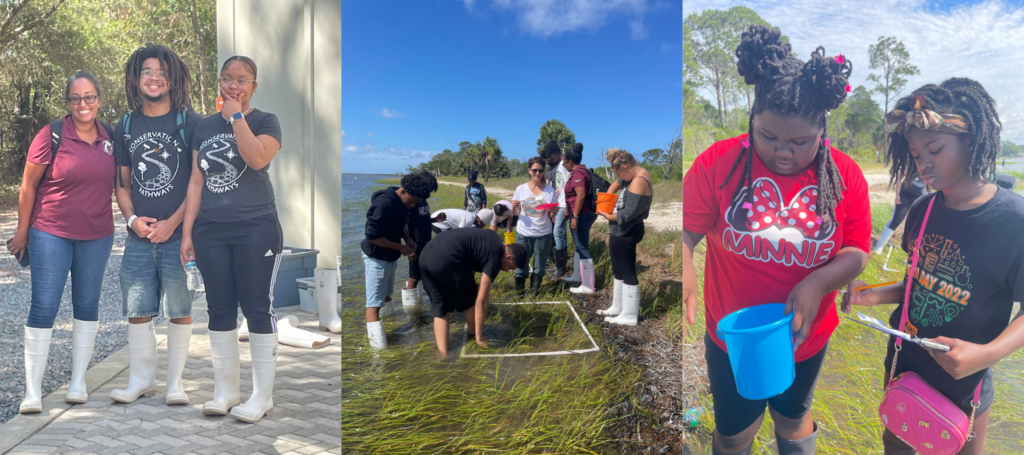
Summer campers engage in various activities at the Reserve.
Summer Oyster Education
What happens when two groups of young women wanting to do a service project at the Reserve met the Oyster Corps? First, a lot of vertical oyster gardens (VOGs) got made. Second, the role of oysters in the ecosystem became much clearer, and beyond that, a positive, constructive role for humans in the watershed became inspiring. After building the VOGs, the girls examined some live specimens from VOGS that had been hanging on a local dock. The summer spotlight at the Reserve that week was the concept of turbidity. It proved relevant to this group as learned that detritus is an essential part of the estuary food web. One of the groups also stayed for the Wednesday Wonders journaling series and took part in the week’s theme – finding mysteries. They created marvelous nature journals on everything from white indigo seed pods to fungus on a leaf. The next day, two more separate groups, (Quincy 4-H, and OTG Invasion) from the northern parts of our watershed participated in a similar water quality project followed by a live VOG exploration with our digital microscopes.

Photo collage of students learning about oysters.
Team-up for Teachers on the Estuary
Everyone measures success differently. When a teacher says, after being in a Teachers on the Estuary (TOTE) workshop, that she will stop rushing her pre-K students everywhere so they can stop and look at ants crossing the sidewalk, that is a success. E.O. Wilson would be happy about. When an AP biology teacher and coach says he didn’t realize he could create art and poetry within science, that is also success. The enrichment that happens when FSU Marine Lab education staff, Rookery Bay staff, and teachers with diverse backgrounds come together makes a Reserve TOTE really magical. This year’s workshop took place at the Reserve, at the FSU marine lab, including on their trawl boat, and on Little St. George Island. At the end of the day, after months of planning, nature is the greatest teacher. All responses from our TOTE survey were very positive and the teachers all plan on using these techniques and materials in their classroom next year.
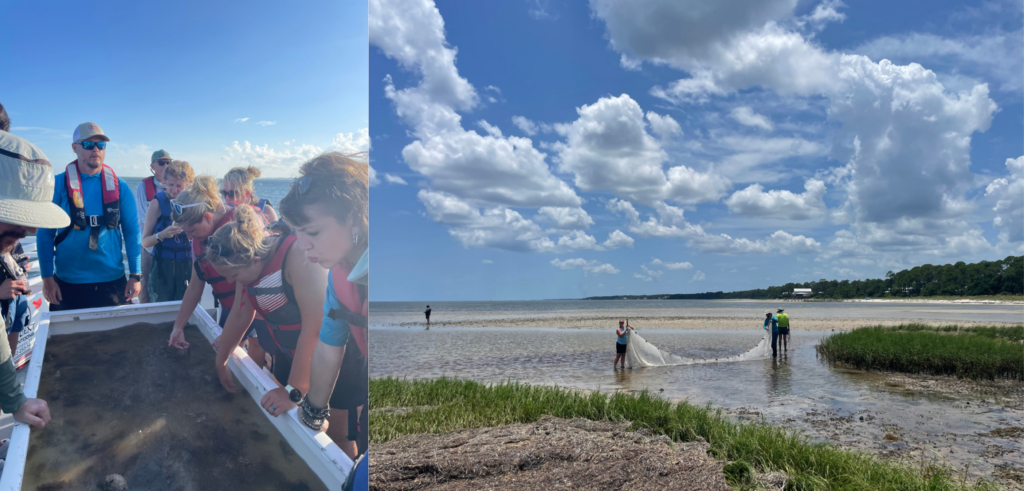
Teachers do hands-on activities as part of TOTE.
What follows is a group poem that was created as a final journaling activity; it is based on the three days of observations done during the TOTE. We can call it Summer Song of the Estuary; the structure is based on a poem by N. Scott Momaday.
I am the iridescent purple-green on the Gulf
I am the blush of the swamp mallow and the creamy froth of the tide line.
I am the summer scent of salt water
I am the buzz of the emerald bay
I am the soaring osprey in the midday sun
I am an eagle looking down at the hermit crab
I am the petrichor of summer
I am the seagrass bed drifting in the waves
I am cicadas hiding in the palms on a calm summer night
I am the purple martins’ melody hovering over the estuary
I am a river of light drawing forth a moth
I am thunder breaking the skies above the bullrush
I am a crab that smiles as the wildflowers grow
I am an oyster summer waits all year round for
I am the whole dream of these things.