
OysterCatcher Spring 2026

ANERR Hosts Research Symposium
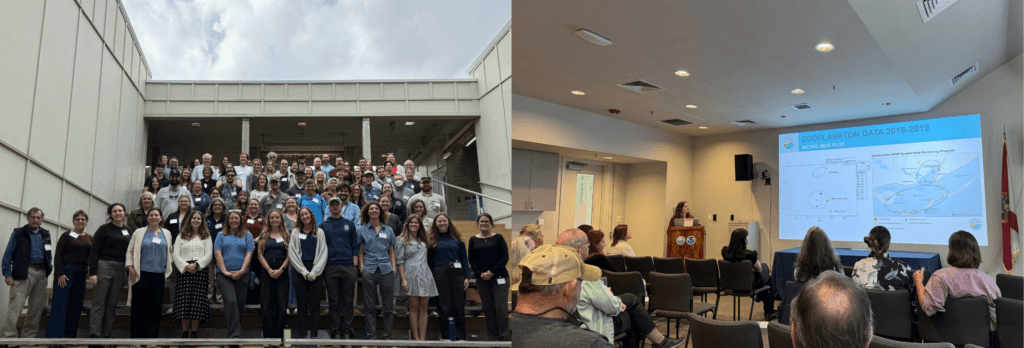
Left: Attendees pose for a group photo! Right: Reserve staff member Samantha Lucas presents about the zooplankton communities in Apalachicola Bay.
In late February the Apalachicola National Estuarine Research Reserve hosted its Semi-Annual Research Symposium. Topics ranged from hydrologic flows in the Apalachicola River, restoration projects, analysis of long-term nutrient dynamics, changes in the marsh, cultural resource studies, and more. Topics highlighted the active research and restoration community around the greater Apalachicola Bay area and highlighted the reserve’s partnerships and community. Reserve staff members Samantha Lucas presented about the bay’s zooplankton communities and Bekah Pagliaro presented about a recent project using drones to categorize marsh vegetation types. A poster session, breaks, and lunch on-site sponsored by the Friends of the Reserve allowed attendees to discuss research projects further, meet new people, and develop new relationships and ideas for study. The event was a great success with the largest number of attendees registered since ANERR started holding this event in 2020.
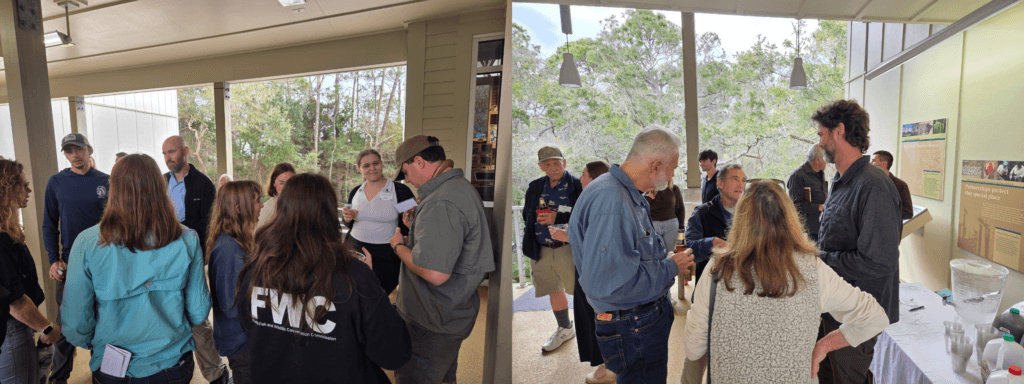
Attendees discussed projects and made connections during the poster session and breaks.
ANERR Research Team Welcomes New Staff Members
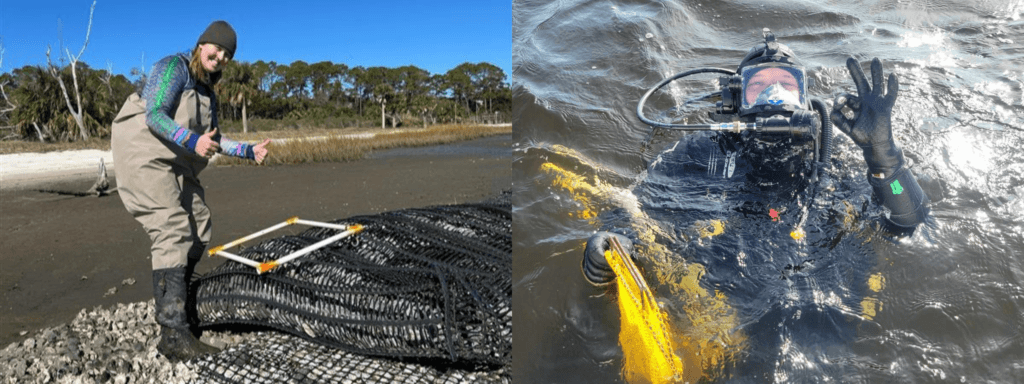
Left: Lena assists with living shoreline assessments at low tide. Right: Lena giving the all ok signal when getting in the water on an oyster bar survey dive.
ANERR’s Research team is excited to welcome new staff to our section! Lena Kury has joined us from the Central Panhandle Aquatic Preserve Office, where she has worked for the past two years contributing to all of CPAP’s many field projects including water quality sampling, oyster surveys, seagrass, living shorelines, and more. Lena possesses advanced SCUBA certifications including Advanced Open Water and is an AAUS Scientific Diver with over 130 career dives. Lena is a native Floridian and received a Bachelor’s degree in Chemistry and Environmental Science from Florida State University, and is currently a remote student at the University of New England pursuing a Master’s degree. Lena will be leading the Reserve’s System-Wide Monitoring Program nutrient and meteorological components.
Meredith O’Donnell has also joined the research team, most recently living in New York but growing up in Pennsylvania. Meredith most recently worked for the National Parks Service conducting pre-restoration marsh data assessments across multiple northeast National Parks and Seashores, including conducting salt marsh vegetation surveys to identify plants, record plant cover, and deploying water loggers to look at wetland water quality. Meredith has a strong background in field work looking at marshes, seagrass, and water quality, and data collection techniques. Meredith has a Bachelor’s degree in Marine Biology from Stockton University. She will be leading the Reserve’s Wetland and Water Levels initiative which includes emergent vegetation monitoring, surface elevation tables surveys, and porewater marsh wetland water quality monitoring.
We are thrilled to have Lena and Meredith join our team!
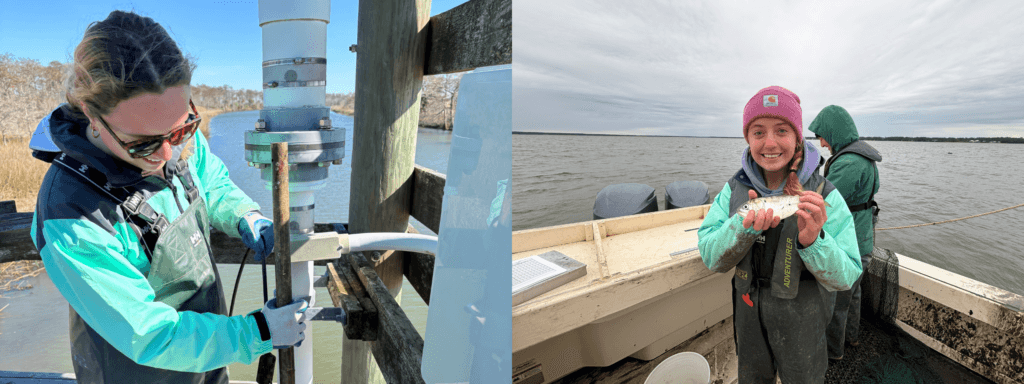
Left: Meredith helps swap the dataloggers at ANERR’s Little St. Marks water quality tower. Right: Meredith assisting with fish counts on a cold winter trawling day.
Apalachicola Reserve and Partners Offer weeklong Restoration Training
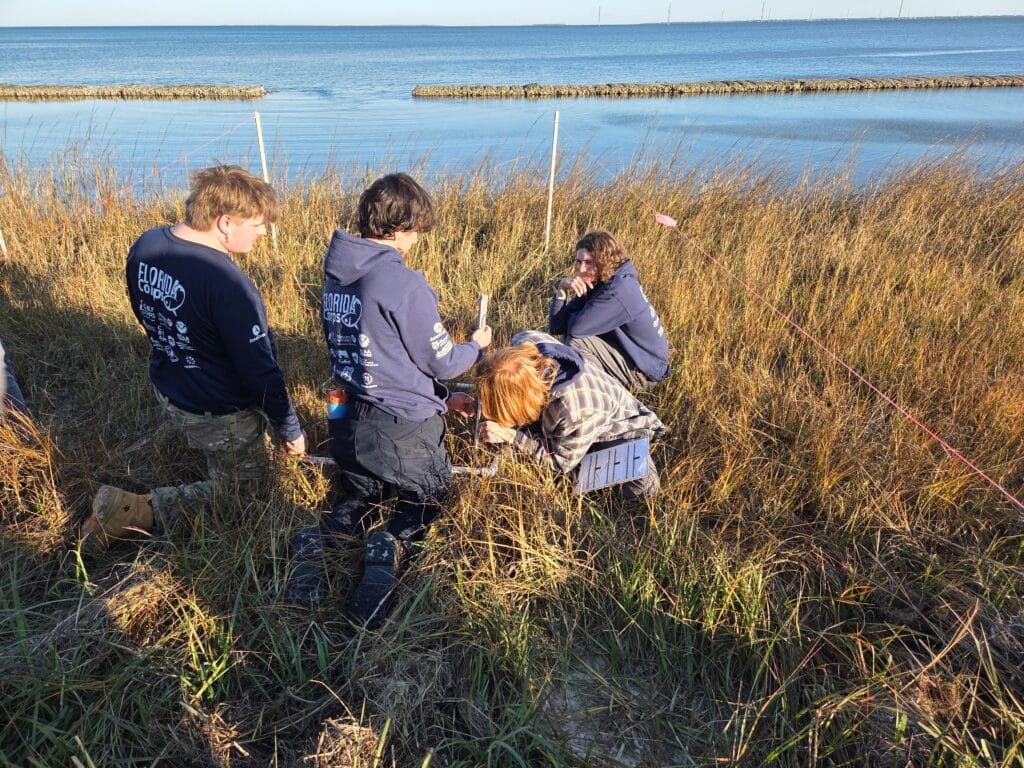
Corps members practice measuring the marsh.
The Apalachicola National Estuarine Research Reserve collaborated with regional partners to host a week-long coastal restoration training for the Oyster Corps February 2–6. The academy featured classroom instruction and field-based demonstrations led by restoration practitioners from across the Florida Panhandle. Sixty Oyster Corps members—from Pensacola to Apalachicola—participated in the training, which was delivered in partnership with the Pensacola and Perdido Bay Estuary Program (PPBEP), UF/IFAS Sea Grant, Choctawhatchee Basin Alliance, Bay County, AmeriCorps, Florida Corps and the Apalachicola Reserve.
Sea Grant agent Rick O’Connor and Zach Schang with PPBEP led the Florida Living Shoreline Contractor course. The curriculum addressed the ecological and engineering principles of living shorelines, including site feasibility assessments, design considerations, regulatory permitting, and the functional benefits of nature-based shoreline stabilization.
Dr. Mark Clark, Associate Professor of Wetland Ecology in the UF/IFAS Department of Soil, Water, and Ecosystem Sciences, and Dr. Savanna Barry with UF/IFAS Sea Grant demonstrated the construction of Oyster Habitat Restoration Panels—engineered, environmentally compatible structures designed to function as oyster substrate and low-profile breakwaters in shallow-water environments. Corps members constructed six panels during the training, which will be deployed in local restoration projects.
Throughout the week, participants gained hands-on experience in contemporary living shoreline techniques and oyster reef restoration methods. The materials fabricated during the academy will be used to restore oyster habitat, reduce shoreline erosion, enhance fisheries productivity, and strengthen coastal resilience across the Florida Panhandle.
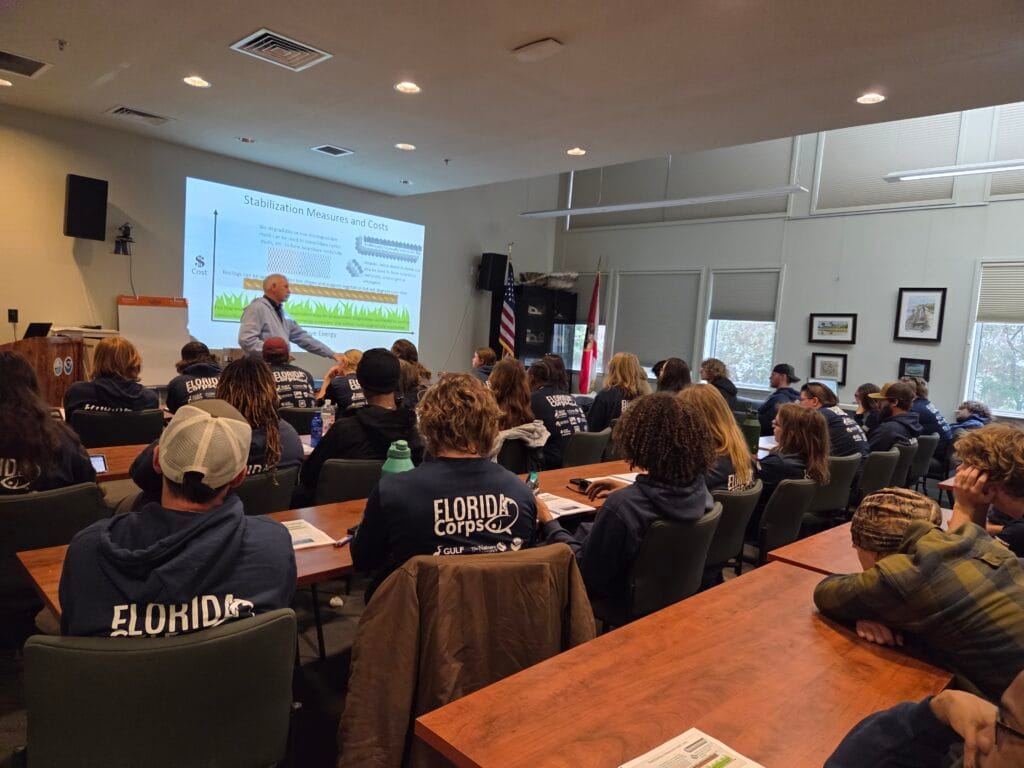
Sea Grant agent Rick O’Conner teaches living shorelines workshop.
Florida Chapter of the American Planning Association Visits the Apalachicola Reserve
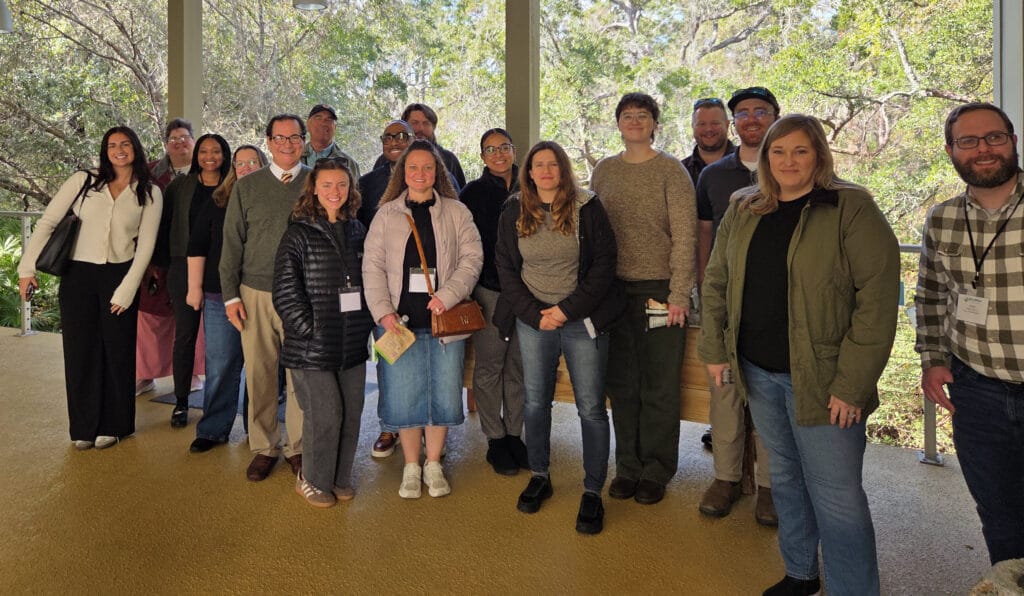
The American Planning Association takes a group photo.
The Apalachicola National Estuarine Research Reserve, in partnership with the Apalachee Regional Planning Council, Florida Corps, and WSP, hosted 18 professional planners from the Florida Chapter of the American Planning Association on January 30 at the Reserve.
Following a training workshop in Tallahassee focused on current planning issues, participants took part in a field excursion through Wakulla and Franklin counties to examine real-world planning challenges and solutions.
During their stop in Franklin County, the group visited the Apalachicola Reserve to learn about the Franklin 98 Living Shoreline project, highlighting the seven-year collaborative effort and the successes achieved through this innovative shoreline protection program.
Flat Tree Oyster Surveys
Stewardship staff at ANERR are collaborating with Dr. James Douglass from Florida Gulf Coast University (FGCU) on a project titled, Flat Tree Oyster Range Assessment. The geographic boundary range for the Flat Tree Oyster, Isognomon alatus, is not well characterized. Anecdotal evidence suggests that their range may be expanding. The goal of this project is to compile a statewide survey to better understand the current range. Staff recently went out to locations across Apalachicola Bay to report on the presence or absence of Flat Tree Oysters through a standardized search protocol at numerous intertidal sites. They are commonly associated with the roots of red mangroves, Rhizophora mangle, but can occur on other hard substrates in both intertidal and subtidal zones. Staff surveyed areas including living shorelines, intertidal oyster reefs, docks, and mangrove marsh. No Flat Tree Oysters were found during surveys, but this information will be valuable in understanding current range.
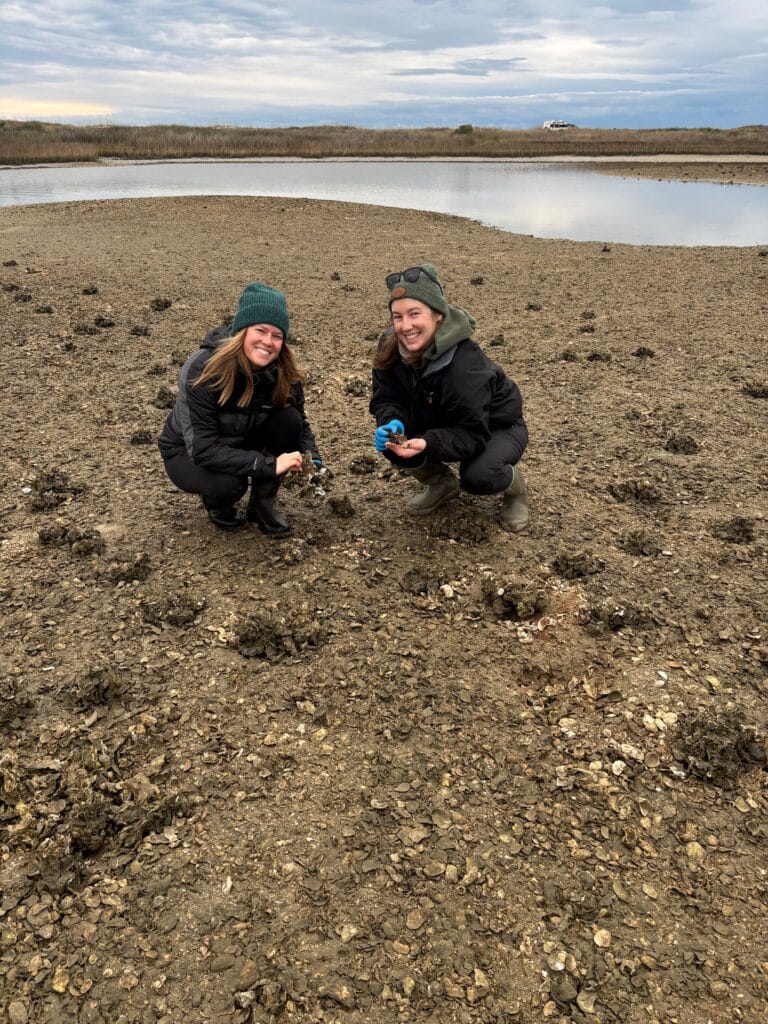
Stewardship staff searching for Flat Tree Oysters at an intertidal oyster reef site.
ANERR + FWC + Florida Audubon
Last week the ANERR stewardship team worked in partnership with Florida Audubon, FWC shorebird biologists, and FWC botanists to tackle invasives plants on the St. George. Island Causeway in preparation for shorebird nesting season. This ongoing project aims to treat vegetation encroaching on shorebird nesting habitat on the Critical Wildlife Area island in the Apalachicola Bay. There are two test plots on the island the teams have been focusing their efforts on. This is the third year the three agencies have come together to treat the test plots. This year, the approach was more intensive than in previous years. Since the shorebirds left the island in the fall, the agencies have come together to treat the plots with herbicide in October, conduct a prescribed burn in December, and just last week, treat the plots with a different herbicide. The goal is to get to mineral soil and prevent herbicide resistance in the plants. All three agencies are hoping to see success from the shorebird species that utilize the island this season!
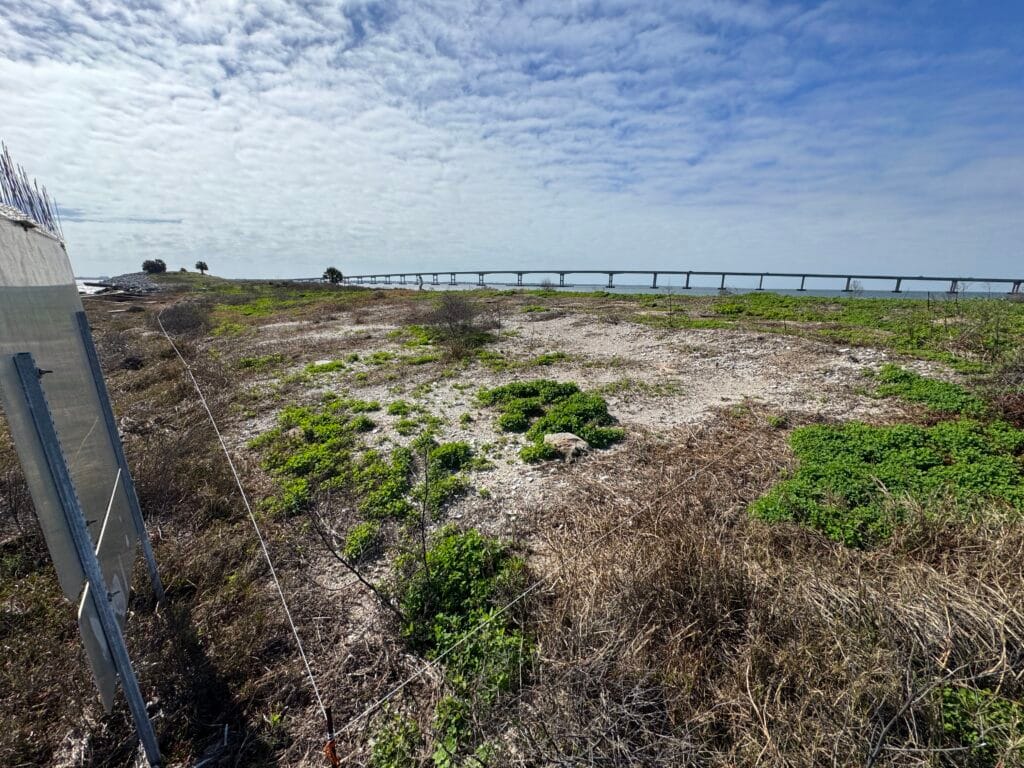
The north test plot pre-treatment.
All SET to Learn
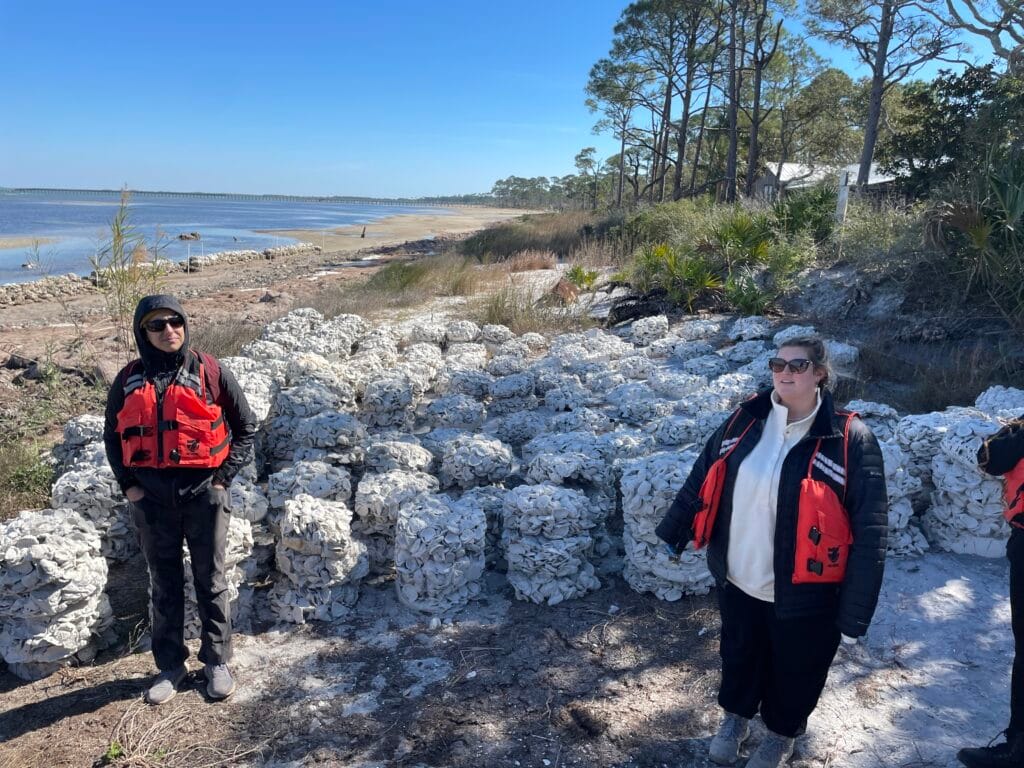
Students examining some of the materials used in living shoreline projects on Little St. George Island.
For the first time, the education staff had the opportunity to integrate the research section’s Sediment and Erosion Tables (SET) Project into a field trip. An FSU geology and environmental science class came to study the bay on board the Tideline where they learned how to measure various water quality and meteorological parameters. It was a fruitful venture as education staff learned a lot about alluvial geology and the students learned about the ecology of the watershed and the reserve’s SET and water quality and meteorological data monitoring programs. In addition to examining the SET data and water parameters, we discussed our living shoreline projects at the nature center and on Little Saint George Island, and a plethora of feathered friends provided an opportunity for some opportunistic birding. A massive flock of redhead ducks swirled near the boat, white pelicans bobbed up and down, and a belted kingfisher surveyed the scene. ANERR’s renaissance man, also the captain, was able to lecture about the tupelo trees after a student inquired about them, and Bob, the education coordinator, got to answer a few questions about freshwater lenses. It was a true integration of multiple disciplines.
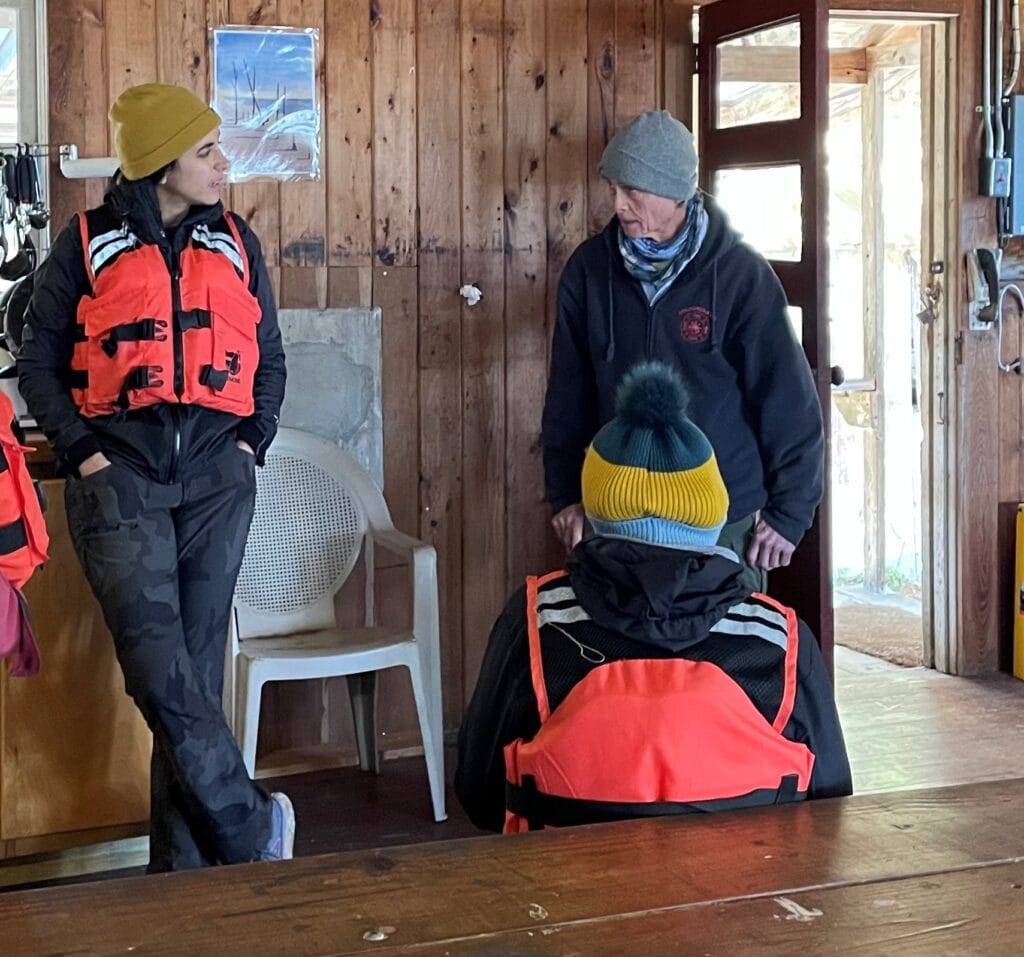
George describing the history of the Marshall House and Little Saint George Island.
“Who made the Shell?” Seahorses Make Shells? and other Theories
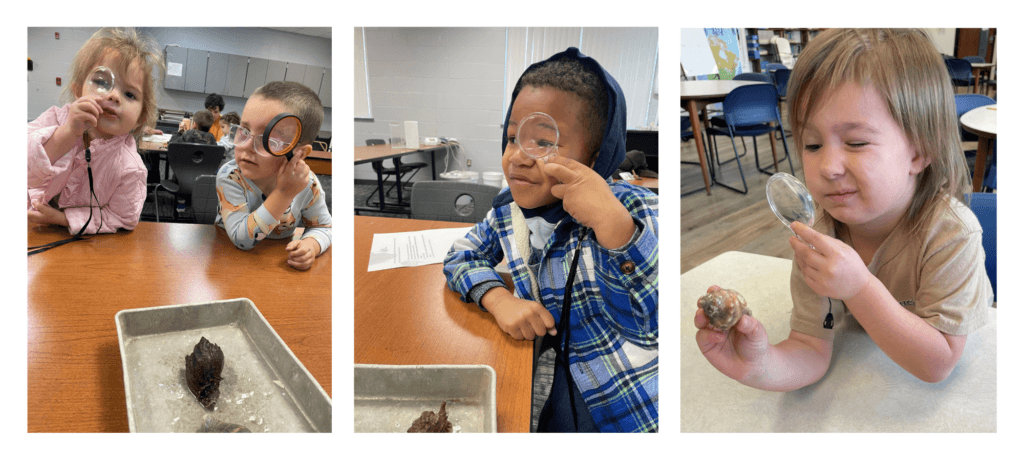
Students learning how to use magnifying glasses and examining shells.
2026 began in a delightful way with education staff, a Training and Engagement assistant, and a Friends of the Reserve board member visiting pre-K classrooms. The class begins with posing a question: Where do shells come from? Among many entertaining theories were the following: seahorses in a little factory, mermaids, the ocean, lobsters, snails, crabs, and turtles. Students examined live snails, live hermit crabs and empty shells at different centers. They still seemed a little dubious when we explained that the snail had made the shell. The students met more critters from the story A Home for a Hermit Crab. The students all enjoyed the story and solving the mystery of “who made the shell?”
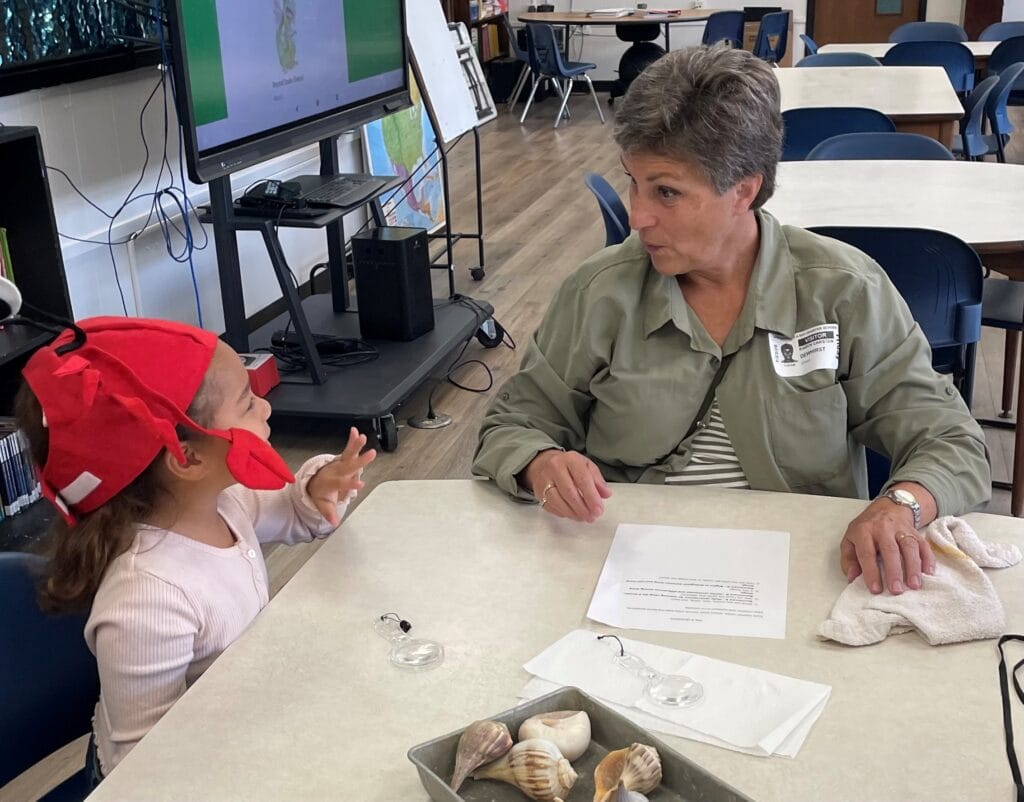
Young student discussing her theory on who made the shell with our education volunteer Karen.