
Apalachicola Biosphere Region
The Apalachicola River, Bay and its watershed encompass what is considered one of the least polluted, most undeveloped, resource-rich systems in the United States. Many protective designations have been granted recognizing the importance of the Apalachicola system. In 1983, the United Nations Educational, Scientific and Cultural Organization (UNESCO) designated Apalachicola as a Biosphere Region.
What is a Biosphere Region?
Biosphere regions are internationally recognized areas of ecological importance that demonstrate how people and nature can work to conserve biological diversity while promoting the sustainable use of natural resources and supporting the well-being and livelihoods of local communities.
They bring communities together to enhance quality of life, strengthen local economies, and conserve the natural systems that sustain them. They educate and inspire others to understand, conserve, and restore these systems so their benefits can be enjoyed for generations to come.
Biosphere Regions galvanize people locally and internationally to build positive relationships between people and the environment. By sharing knowledge, resources and expertise, communities and organizations can develop collaborative solutions to achieve greater impact together.
Our quality of life, cultural heritage, economies, and human well-being depend on healthy natural systems. Biosphere Regions help communities recognize these connections and take action to protect and restore the lands and waters that sustain them.
Where are Biosphere Regions?
Biosphere Regions make up an extensive global network of protected areas covering over 797 sites in 124 countries. This international network protects some of the world’s major ecosystems and is devoted to conservation of nature and scientific research in the service of man. Local communities, state and national officials, businesses, scientific and educational institutions work together to develop integrated conservation management for the biosphere regions. The United States has 28 biosphere regions.
What are the benefits of being a Biosphere Region?
The Biosphere Regions provide a conceptual framework to guide and reinforce projects to enhance people’s livelihoods while ensuring environmental sustainability. They view human beings as part of a wider living community and foster respect and consideration of natural systems. Designation of a site as a Biosphere Region also raise awareness among local people and government authorities on environmental and development issues. At the global level, Biosphere Regions can serve as pilot sites or “learning laboratories” to explore and demonstrate approaches to conservation and sustainable development, providing lessons which can be applied in areas throughout the world.
Functions of a Biosphere Reserve:
Biosphere reserves seeks to fulfill three complementary functions:
- Conservation of ecosystems, species, genetic variation and cultural landscapes.
- Foster sustainable economic and human development that is socio-culturally
and ecologically sustainable. - Support environmental education and training, demonstration projects, and
research and monitoring related to local, regional, national and global issues
of conservation and sustainable development.
How do Biosphere Regions compare to world Heritage Sites?
Biosphere Regions are similar to UNESCO World Heritage Sites. Both programs are coordinated by UNESCO and seek to conserve special places. World Heritage Sites recognize and protect cultural and natural sites that have outstanding universal value and serve our common human inheritance. Biosphere Regions help preserve biodiversity while fostering sustainable use. World Heritage Sites protect the past and biosphere regions strive to protect our future.
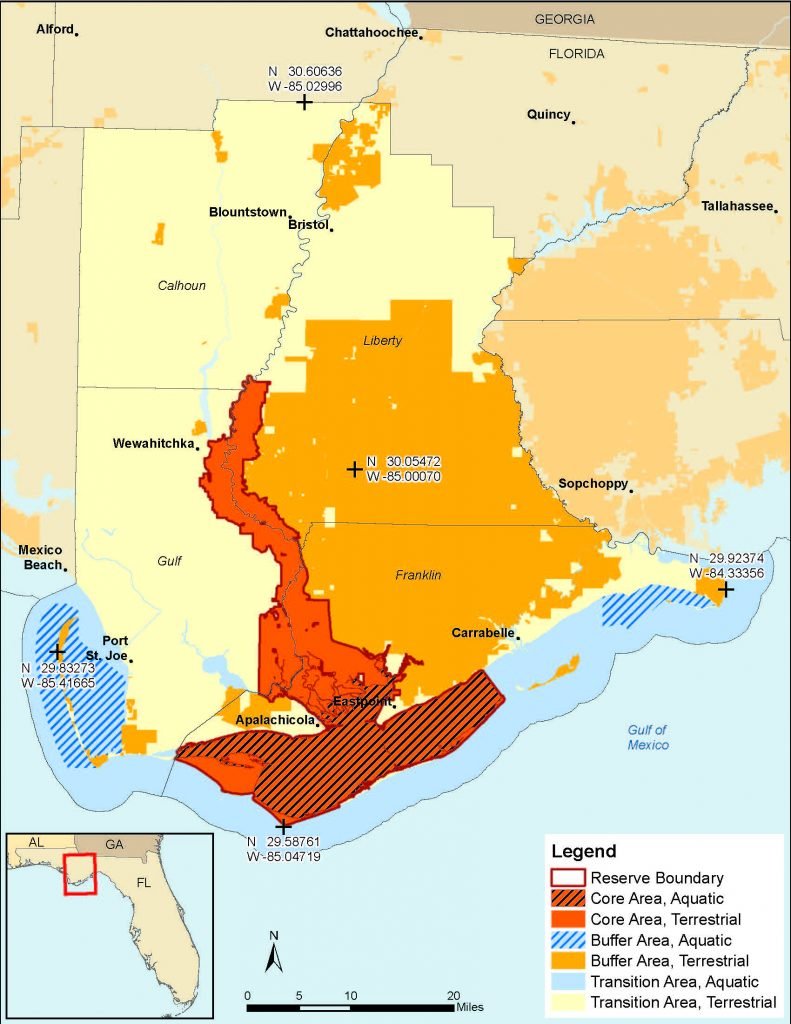
The Biosphere consists of three areas:
- The Core Area, a strictly protected system that contributes to the conservation of landscapes and species.
- The Buffer Area, which surrounds the core is used for activities compatible with sound ecological practices, like hiking, fishing, and camping.
- The Transition Area where human development is allowed in ways that are economically and ecologically sustainable.
- Franklin 1026 sq miles – 656,640 acres
- Gulf county 756 sq miles – 483,840 acres
- Liberty 843 sq miles – 539,520 acres
- Total = 1,680,000 acres
The Apalachicola Biosphere encompasses 1,615,000 terrestrial and 432,600 aquatic acres across Calhoun, Gulf, Franklin and Liberty counties in the central panhandle of Florida. At the core of the Biosphere is the Apalachicola National Estuarine Research Reserve, where the greatest protection occurs for 235,000 acres in the Apalachicola River and Bay area.
Our biosphere is one of the most productive estuarine systems in the Northern Hemisphere. It provides a home to over 54 species of plants and animals who find themselves listed as endangered, threatened, or of special concern in addition to having the highest density of reptiles and amphibians north of Mexico.